
In the Ezugi Over the Table (OTT) Andar Bahar rules used here, a Bahar bet can win at a profit rate of 0.25:1 when the very first card after its betting window matches the reference card. A stake of 100 then returns 125: the original 100 plus 25 profit. It does not mean that only 25 of your stake comes back.
There is another important detail: this version has two betting windows. If Bahar wins immediately after the second window, a Bahar bet accepted in the first window pays 1:1, while a new Bahar bet accepted in the second pays 0.25:1. The winning side is the same, but the two bets entered at different points in the deal.
This Dubai7 guide explains that specific OTT version, using the published Ezugi rules in Evolution’s v2.7.4 rulebook. It is not a description of every Andar Bahar table, or a claim that this version is currently available through our registration link. All amounts and card sequences below are teaching examples.
First check the version: OTT starts on Bahar
The dealer reveals a reference card, often called the Joker. Here, “Joker” means that exposed ordinary playing card; it is not an extra wild card. The round ends when a dealt card first matches its rank, regardless of suit.
Suppose the reference is 7♣. A 7♥ is a match; another club such as Q♣ is not. You are checking the rank seven, not trying to collect a particular colour or suit.
For the OTT rules discussed here, the first card after the reference goes to Bahar, the second to Andar, and the sides then alternate. That makes the third card Bahar, the fourth Andar, and so on.
Do not import the dealing order from a different table. The same rulebook separately describes an ordinary Andar Bahar version that starts on Andar and lists different payouts. A familiar game name or a left-hand position on a screen is not enough to identify which rules govern your bet.
Two betting windows do not mean one bet gets renewed
The first window opens after the reference card is revealed. If neither of the first two dealt cards matches it, the dealer can open the second window before dealing the third card. If the round has already ended on the first or second card, there is no second window to join.
| Point in this example | What has happened | What the next card means |
|---|---|---|
| First window | Reference card revealed; no side cards dealt | Next card is Bahar's first card |
| Second window | Bahar card 1 and Andar card 2 both failed to match | Next card is Bahar's second card, but the first after this new window |
| After the second window | New bets have closed | Cards continue alternately until the first rank match |
A first-window bet stays associated with that window. Placing another bet in the second window creates an additional stake; it does not move the old stake into the new window or refund it. You also do not have to place a second bet merely because a new window opens.
This is why “the first card” needs a reference point. Card 3 is the third card dealt after the reference, but it is the first card dealt after the second window. Treating both phrases as the same count is what makes the reduced payout look inconsistent.
Read 0.25:1 as profit, then add the winning stake once
For a winning 100 stake, the two profit rates used in this OTT example produce these returns:
| Profit rate | Profit on 100 | Total returned, including stake |
|---|---|---|
| 0.25:1 | 25 | 125 |
| 1:1 | 100 | 200 |
The 0.25:1 figure is not a 25 total return. Equally, a 125 total return is not 125 profit. For the individual winning bet, net profit is total returned minus that bet’s stake.
These figures apply to the named rulebook version. A screen using “x1.25,” “return,” or “win” may describe the same amount differently, or may use another paytable altogether. Match the label to the actual settlement definition before comparing the numbers; do not assume every multiplier is a profit rate.
Follow one round: first Bahar bet returns 200, second returns 125
Use reference card 7♣ and this short deal. There are no side bets, fees or other transactions, and both hypothetical Bahar bets are validly accepted at their stated windows.
| Dealt card after the reference | Side and card | Result at that point |
|---|---|---|
| 1 | Bahar: Q♥ | Not a seven; continue |
| 2 | Andar: 3♦ | Not a seven; second window can open |
| 3 | Bahar: 7♥ | First rank match; round ends on Bahar |
Suppose you placed Bahar 100 in the first window, then another Bahar 100 in the second. Card 3 is not an immediate first-card win for the earlier bet, so that earlier winning stake pays at 1:1: 100 profit plus its 100 stake, returning 200.
For the second-window stake, however, card 3 is the very next dealt card. Its winning rate is 0.25:1: 25 profit plus its 100 stake, returning 125. Total returned from both bets is 200 + 125 = 325, against total stakes of 200, so the round’s net result is +125.
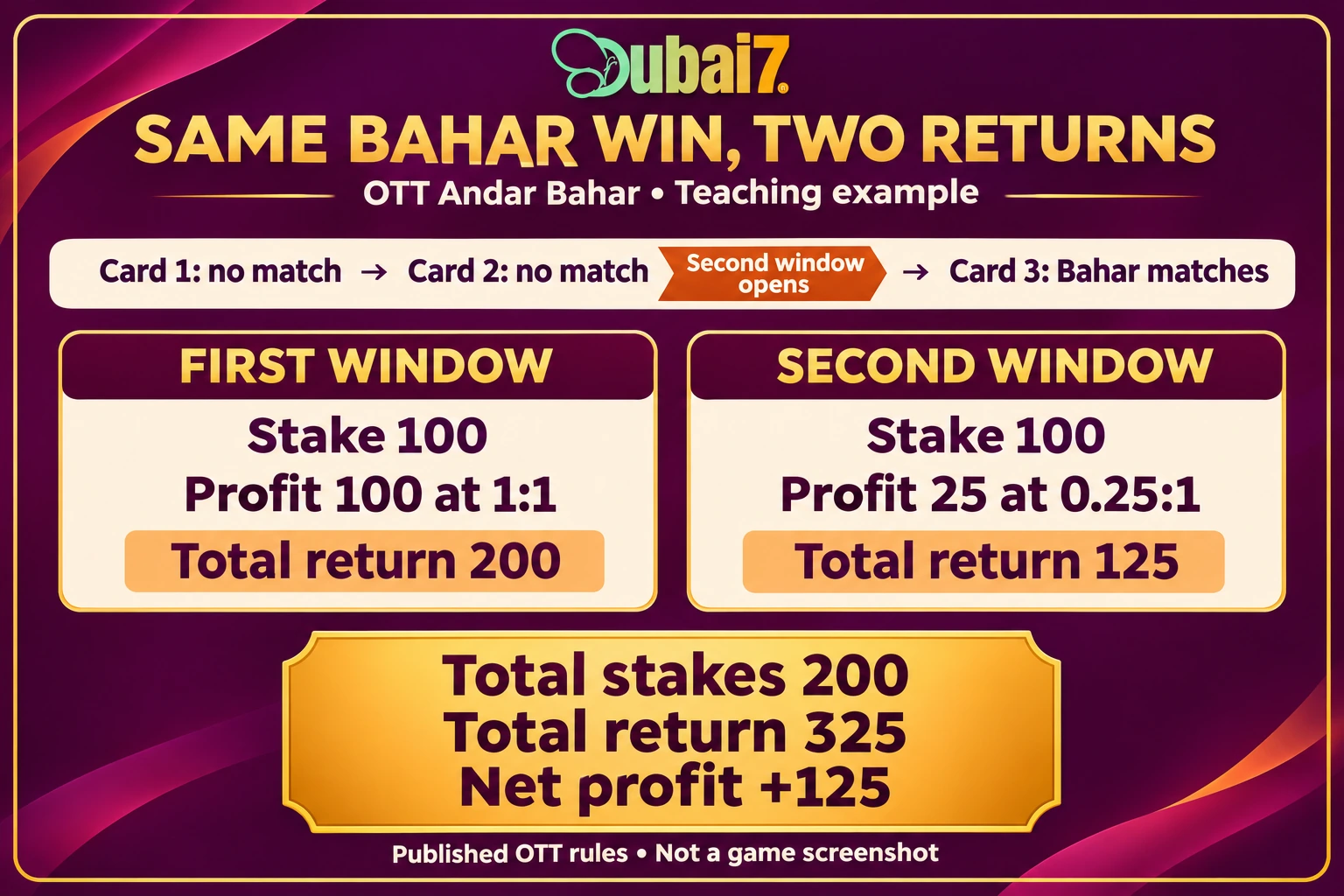
The balance gives another way to check it. Starting with 1,000, the first stake leaves 900, the second leaves 800, and the combined 325 return brings the final balance to 1,125. Do not add another 200 for the stakes: their return is already included in the 325.
This example explains settlement after a specified result. It does not say that placing a second bet improves your expected result or that Bahar is more likely to win next.
Change the matching card, and the account changes too
Keep the first-window Bahar stake at 100. Add a second-window Bahar stake of 100 only when that window actually opens. In the following separate examples, every earlier dealt card has failed to match the reference.
| First matching card | Which Bahar stakes exist? | Total returned and round net |
|---|---|---|
| Card 1, on Bahar | First-window 100 only | 125 returned; net +25 |
| Card 2, on Andar | First-window 100 only | 0 returned; net −100 |
| Card 3, on Bahar | First 100 and second 100 | 325 returned; net +125 |
| Card 4, on Andar | First 100 and second 100 | 0 returned; net −200 |
| Card 5, on Bahar | First 100 and second 100 | 400 returned; net +200 |
The last row is different from card 3. By card 5, Bahar is no longer winning on the first card after either betting window, so both winning stakes use the 1:1 profit rate in this version.
The card 4 row matters just as much: two valid stakes mean twice the amount at risk. A second betting window is not a free chance to repair the first bet. If Andar wins, both of these Bahar stakes lose.
If a payout looks wrong, compare the bet’s window before its amount
A useful settlement record needs more than a screenshot saying “Bahar wins.” For this particular question, keep the round identifier, exact game/provider name, rule version, each accepted stake with its window, and the deal up to the first matching rank. Also keep the displayed profit or return label and the balance entries.
Then reconstruct each stake separately. Ask which side it backed, when it was accepted, whether the winning card was the first after that window, and whether the quoted amount includes the stake. Only after those checks should you add the returns and subtract the full round cost.
If the history lists just one combined Bahar amount and does not identify when its components were accepted, that alone cannot prove the applicable rate. Ask support to identify the accepted first- and second-window wagers for that round. Do not assume that pressing a button established a bet unless it appears as accepted in the record.
Common questions
Does the reference Joker count as card 1 in these examples?
No. Our count starts with the first card dealt to a side after the reference. The reference is 7♣ in the example; Bahar’s Q♥ is card 1. Counting the reference as card 1 shifts every subsequent position and gives the wrong window comparison.
What if I only place the second-window Bahar bet?
If that valid window opens and your 100 stake is accepted, an immediate Bahar match on the next dealt card returns 125 under these rules. You cannot add the 200 return from our first-window bet, because you did not place that separate stake.
What does an Andar bet receive if Andar wins?
The cited OTT table pays a winning Andar stake at a 1:1 profit rate. For a valid 100 Andar stake, that is 200 total returned. The immediate-first-card reduction discussed above is the Bahar condition; it should not be applied to a winning Andar bet merely because the game has two windows.
Can I carry a card-count side bet into the second window?
The published OTT rules allow those side bets only in the first window. They are separate from the main Andar/Bahar stakes. This article does not assign them a payout from the main-bet table or include an unplaced side bet in the round totals.
The dealing order, window conditions and profit rates above come from Over the Table Andar Bahar in the published Evolution/Ezugi rulebook, physical PDF pages 309–311. We used the separate ordinary-version section only to distinguish versions. The sequence, balance account and illustrations are Dubai7’s own teaching examples, not game screenshots or records of a real player’s account.