
Crazy Time Cash Hunt payout: why a boosted 15x is not multiplied by Top Slot again
If Cash Hunt’s displayed 15x has already been raised by a 3x Top Slot, use 15x once—not 15 × 3 again. In the published Evolution rules explained here, the applicable Top Slot factor is applied to all 108 Cash Hunt multipliers before they are covered and shuffled. A base 5x becomes 15x at that stage. Revealing that updated 15x does not create a second Top Slot award.
The essential distinction is between an original multiplier and an already updated one. A history field that only says “15x” without identifying its stage cannot, by itself, tell you which you are reading. This Dubai7 guide follows the cited Crazy Time v2.7.4 rules and builds a complete hypothetical account around that timing, rather than describing every operator’s result-history format.
Cash Hunt needs its own accepted bet
Crazy Time’s main wheel has separate number and bonus bet spots. Seeing the wheel stop on Cash Hunt does not turn every stake on the table into a Cash Hunt stake. Under the cited rules, everyone may watch a bonus, but participation and its winnings belong to players who placed an accepted bet on that particular bonus spot.
Suppose a round contains Cash Hunt 10 and number 2 for 5, a combined cost of 15. If the wheel stops on Cash Hunt, the Cash Hunt stake proceeds to that bonus. The 5 placed on number 2 does not also receive the Cash Hunt multiplier. If someone had placed only number 2, watching the same bonus would not establish an accepted Cash Hunt wager for that person.
The Top Slot has a separate matching condition too. Its two reels must align the relevant bet spot and multiplier, and the main wheel must land on that spot for the factor to apply. A factor assigned to Pachinko is not a general multiplier for a Cash Hunt result in the same spin.
| Top Slot and main wheel in an independent example | Does that factor boost Cash Hunt? | Reason |
|---|---|---|
| Cash Hunt aligned with 3x; main wheel lands Cash Hunt | Yes | Same matched spot and winning bonus |
| Pachinko aligned with 3x; main wheel lands Cash Hunt | No | The factor belongs to Pachinko |
| Reels do not form the required aligned match | No Top Slot factor from that display | A visible number alone is insufficient |
| Cash Hunt aligned with 3x; main wheel lands number 2 | No Cash Hunt bonus on that spin | A Top Slot selection does not force the wheel result |
These are settlement conditions, not forecasts. The Top Slot display does not guarantee that its selected bonus will be the wheel’s winning segment.
The 108 values are raised before the hidden-target choice
The Cash Hunt section describes a wall with 108 random multipliers. If an applicable Top Slot multiplier exists, it raises all 108 values. The updated values are then covered by symbols and shuffled, after which a countdown gives the player time to aim at a target. The reveal identifies the selected multiplier.
That sequence matters more than the animation’s speed. There is one applicable Top Slot factor in this account, not a factor for showing the wall and another for uncovering it. A number seen before a boost and a number seen after it represent different stages of the same calculation.
| Stage of our example | Value for one hypothetical target | Calculation still needed |
|---|---|---|
| Original wall value | 5x | Apply the applicable 3x once |
| Wall after the boost, before cover and shuffle | 15x | The factor is already included |
| That updated target is selected and revealed | 15x | Apply it to the accepted Cash Hunt stake |
Do not use the position of a briefly visible high value as proof of where it will be after the shuffle. Equally, the document’s mention of 108 targets does not establish the distribution of their values, a measured chance of a particular payout, or a guaranteed best corner. Those would require evidence beyond this sequence.
Work through 10 on Cash Hunt, plus a separate losing 5
Return to the two accepted stakes: Cash Hunt 10 and number 2 for 5. Assume the main wheel validly lands on Cash Hunt, the Top Slot has validly assigned Cash Hunt a 3x boost, and the selected target’s original value was 5x. No fees, other wagers, payout-cap restriction or additional transactions apply in this teaching account.
The 5x is first raised to 15x. Under the cited rulebook, the bet on the winning segment is returned in addition to the winnings. Treating that 15x as the profit multiplier gives 10 × 15 = 150 winnings, plus the winning Cash Hunt stake of 10: total returned 160.
| Entry in this hypothetical round | Amount | Meaning |
|---|---|---|
| Accepted Cash Hunt stake | 10 | The stake that earns the bonus payout |
| Accepted number 2 stake | 5 | A separate losing stake on this result |
| Total cost | 15 | Both accepted stakes, not just the winner |
| Cash Hunt winnings | 150 | 10 × the already updated 15 |
| Winning stake returned | 10 | Included once in the total return |
| Combined return | 160 | Cash Hunt 160 plus number 2 return 0 |
| Net round result | +145 | 160 minus total cost 15 |
Starting from 1,000 makes the balance check straightforward. Accepting the two stakes leaves 985. Adding the 160 return ends at 1,145. The balance has risen by 145, which matches the net round result.
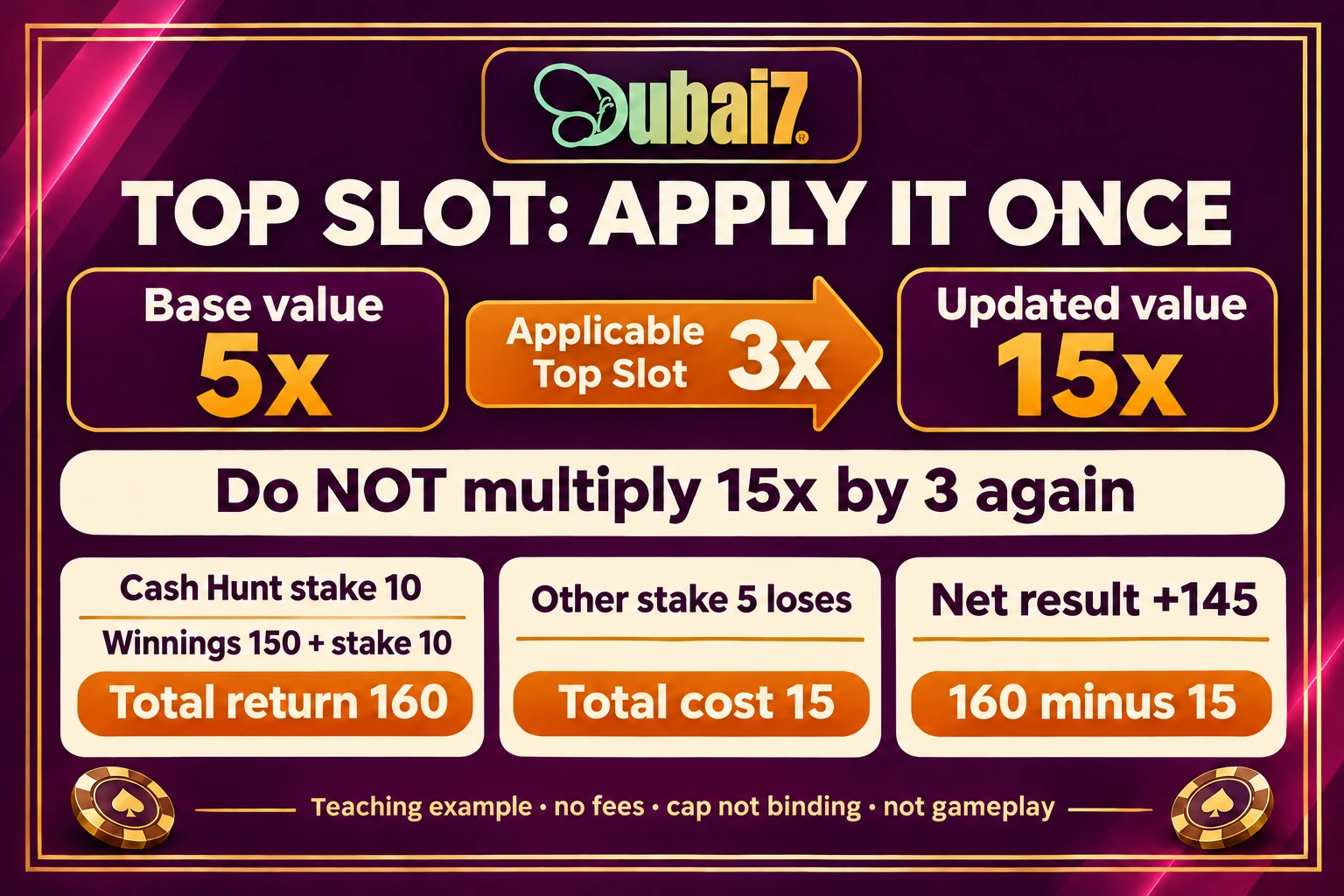
There are two different mistakes to avoid here. Calculating 10 × 15 × 3 applies the Top Slot twice. Calling the round’s gain 150 overlooks the separate losing 5. The correct net figure comes from the whole accepted account, not the largest highlighted figure in the bonus.
If you had placed only Cash Hunt 10, the same valid target result would return 160 against a cost of 10, giving net +150. That is a different account. Do not carry the losing 5 into a one-stake example or remove it from the two-stake example halfway through the calculation.
Two players can receive different Cash Hunt multipliers
The target choice belongs to the individual player. The supplier’s Crazy Time guide describes players choosing their own symbols and receiving their own revealed multiplier. Seeing a stream or another person’s result is therefore not enough to establish the multiplier selected for your accepted bet.
For a separate example, suppose two eligible players each stake 10 on Cash Hunt, and their final, already updated multipliers are 10x and 40x. Using the same return convention, their returns are 110 and 410 respectively. The main wheel triggered the same bonus, but their personal revealed values differ. Neither player automatically receives the largest value visible anywhere on the wall.
A result tracker may show a round-level value without identifying a player’s selected target. Before using that value in an account, establish what the field represents. A wall maximum, a base value and a personal final multiplier are three different quantities; a page’s use of the word “result” does not make them interchangeable.
A history record must identify which multiplier it contains
For this particular question, useful evidence includes the exact game and provider, round identifier, accepted Cash Hunt stake, other accepted stakes, Top Slot matched spot and factor, main-wheel result, and the player’s selected final value. Preserve the field labels as well as the numbers.
Then separate the calculation into two steps. First determine the final bonus multiplier: if the record supplies the original value, apply the valid factor once; if it already supplies the updated final value, do not apply it again. Next calculate that accepted stake’s return under the stated payout convention and subtract every accepted stake to get the round’s net result.
If a cropped history screen gives only an unexplained “15x,” the missing stage is a real evidence gap. Ask for the original-versus-final distinction or a round breakdown rather than assuming that every Top Slot number must be added to every number in the history. The example here cannot establish a specific interface’s undocumented labels.
The cited rulebook also says the round’s maximum payout is limited by its Bet Limit table. Our small account explicitly assumes no cap affects it; it does not establish a maximum cash amount for another operator or currency. A limit must be checked before extrapolating the same formula to a very large balance entry.
Common questions
Does betting on all four bonuses mean I collect all four bonus games?
No. An accepted Cash Hunt stake receives Cash Hunt settlement only if that spot wins. Separate bets on other bonus spots do not become additional Cash Hunt stakes. Include their losses when reconstructing the whole round rather than multiplying the total amount spread across all spots by the winning bonus value.
Can I use the Crazy Time bonus wheel’s DOUBLE or TRIPLE rule on Cash Hunt?
They are different bonus games. The cited Cash Hunt passage describes its 108 values, applicable Top Slot, cover, shuffle and target reveal. It does not add the separate Crazy Time World wheel’s DOUBLE/TRIPLE respin procedure to that target selection.
If I did not make a selection, can I use the wall’s highest value?
The fact that a high value was on the wall does not prove it was selected for your wager. The cited v2.7.4 Cash Hunt paragraph does not specify the timeout-selection procedure. Check the applicable table’s own rules and recorded personal result for that situation; do not transfer the separately stated random-flapper rule of Crazy Time World to Cash Hunt.
Is a 15x reveal always a 15:1 profit payout on every site?
The worked account follows the cited rulebook’s winning-stake-plus-winnings convention and identifies the revealed value as already updated. Another screen may label total return differently or show a value at an earlier stage. The label, rule version and accepted stake must agree before a monetary result can be established.
The boost-before-cover sequence and stake-return convention come from Evolution’s published Crazy Time rules, physical PDF pages 15–17. Evolution’s current Crazy Time guide also describes Cash Hunt’s 108 targets and individual outcomes. The amounts, stage comparison and diagram are Dubai7 teaching examples, not real account records or a claim that a game is currently offered at our destination.