
Deal or No Deal first offer expired: why the displayed quote was not paid
In the published Deal or No Deal rules used here, letting the first offer’s decision timer expire is interpreted as NO DEAL. The game continues; the displayed offer is not automatically credited. Receiving an offer and accepting it are different events.
The final offer also presents three distinct choices: take the banker’s quote, keep the assigned briefcase, or switch to the other briefcase. Those are alternative outcomes, not three prizes to add together. To check a balance, identify which decision was actually accepted before using a displayed amount as a payment.
This Dubai7 explanation follows the live Deal or No Deal section of Evolution’s v2.7.4 rulebook. It is not a description of every TV adaptation, First Person version or operator interface. The document expressly states the first-offer timeout rule; it does not separately spell out the final-offer timeout outcome, so we do not invent one below.
Qualification costs happen before the offer
In the cited version, joining the game show requires qualification within the qualification period. The ordinary qualification process uses a three-ring wheel, and each spin costs the selected bet amount. A failed qualification spin is therefore part of the account, even if a later spin lets the player enter the show.
For the teaching account used throughout this article, suppose the transaction record shows three ordinary qualification spins charged at 2 each. The first two do not qualify, and the third does. Total recorded cost is 6. There are no bought-ring modes, Top Up charges, fees or other transactions in this example.
That example is not a fixed entry price. The rulebook also describes paid ring options and a separate optional Top Up phase. A real account using those features needs its own actual charges included; copying only the last qualifying spin’s amount would leave earlier accepted costs out.
The qualification wheel should not be confused with the banker’s offer. An amount used to establish or increase a briefcase’s value is not, just because it appears on screen, an amount already paid to the balance. Qualification, briefcase values, offers and settlement each play a different role.
Four openings reduce 16 cases to two
The show starts with 16 briefcases. Cases are progressively removed, and the banker makes four offers. Reading those stages in order helps distinguish the first quote that expired from a later quote or a final case value.
| Offer stage | Cases opened at that stage | Cases remaining |
|---|---|---|
| First | 3 | 13 |
| Second | 4 more | 9 |
| Third | 4 more | 5 |
| Fourth and final | 3 more | 2 |
The numbers are not four independent counts from a fresh set of 16. After the first three openings leave 13, the next four are taken from those remaining cases, leaving nine. Across all four stages, 3 + 4 + 4 + 3 = 14 cases have been opened, so two remain.
A removed high-value case does not itself establish a payment to the player. Its displayed amount identifies a case no longer participating in the show. Likewise, the remaining highest amount is not automatically the current banker’s quote or the amount inside the assigned case.
What the first timer does—and does not—accept
The first opening is followed by a DEAL or NO DEAL offer. The cited passage defines all three first-offer situations:
| First-offer event | Effect under the cited rule | Is that quote collected? |
|---|---|---|
| DEAL accepted | The displayed winning amount is added to the balance; return to qualification is offered | Yes |
| NO DEAL selected | Continue playing | No payment of that quote |
| No choice before the decision time expires | The choice is interpreted as NO DEAL | No payment of that quote |
Suppose the first displayed quote in our invented account is 10. If DEAL is validly accepted, that quote is collected and that player is offered a return to qualification. If the first timer instead expires, the rule treats it as NO DEAL; a later screen still showing 10 is not evidence that a 10 credit should already be present.
A button press alone may not establish which action reached the game in time. For a particular disputed record, check the accepted response and its stage rather than assuming that an attempted late click overrode the documented timeout. The published rule does not supply the internal timestamp or acknowledgement for a specific interface.
Continuing after that first timeout also does not mean the player has already selected the last briefcase or agreed to a later offer. The account must still follow the later stages and the actual accepted final decision.
The final three choices refer to different amounts
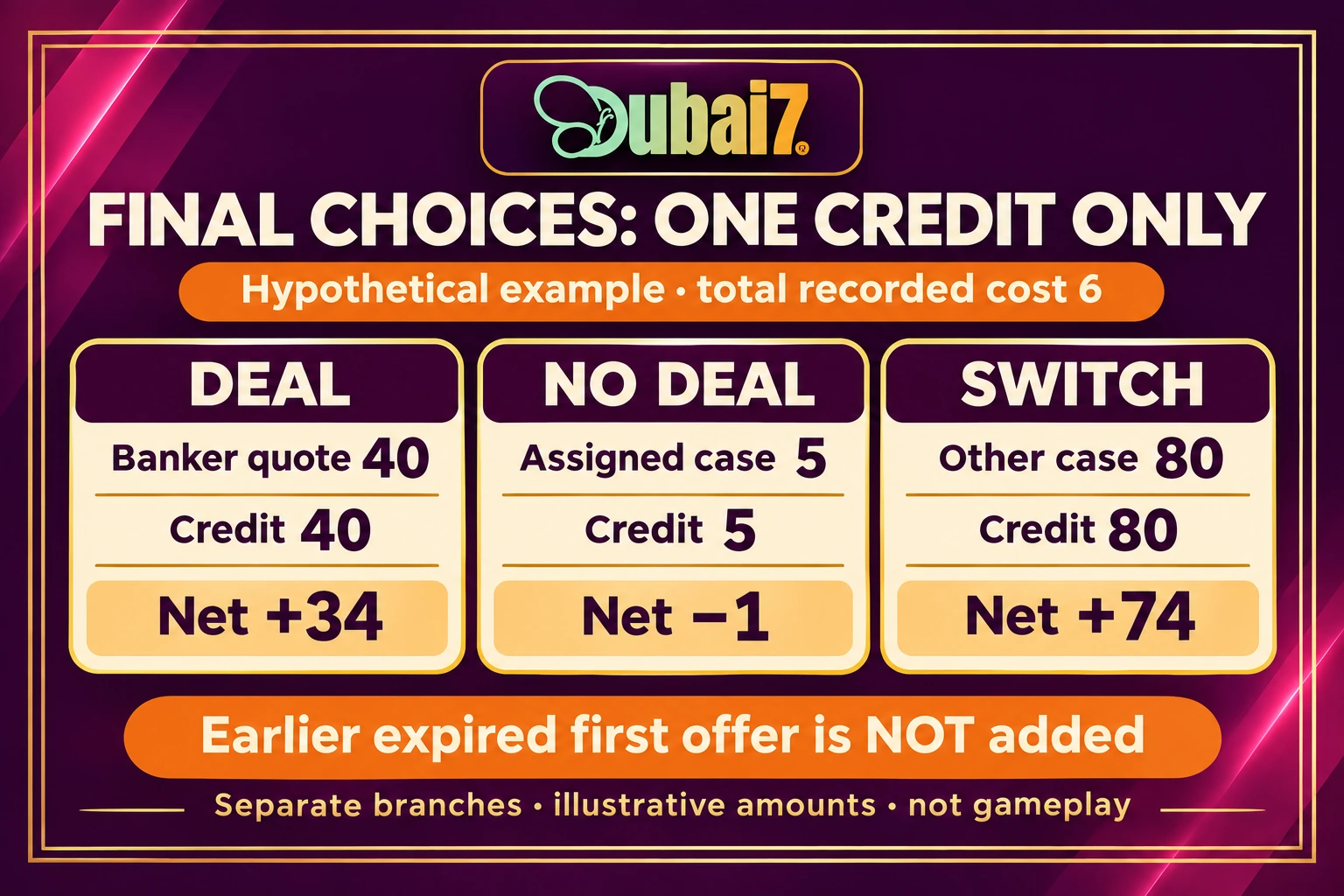
When only two briefcases remain, the cited rules offer DEAL, SWITCH BRIEFCASES or NO DEAL. DEAL collects the banker’s final offer. NO DEAL takes the prize in the assigned briefcase. SWITCH BRIEFCASES takes the prize in the other remaining briefcase.
Use a separate invented final-stage display: banker quote 40, assigned-case prize 5 and other-case prize 80. These are teaching amounts, not a claim about the provider’s offer-generation formula or an actual round.
| Accepted final decision | Amount selected in this example | What is not added |
|---|---|---|
| DEAL | Banker quote 40 | Neither case prize is an extra award |
| NO DEAL | Assigned-case prize 5 | The rejected quote 40 is not paid too |
| SWITCH BRIEFCASES | Other-case prize 80 | The assigned-case 5 is not collected as well |
The comparison is about the meaning of the decision, not advice on which one to choose. The table does not establish that the two remaining case values are equally likely, or that an offer is fair or unfair relative to a mathematical expectation.
Also preserve the assignment in the actual record. “The other case” means the other of the final two relative to the assigned one. A screenshot containing two amounts without the case assignment and accepted decision cannot identify which amount settles that player’s choice.
Subtract the full recorded cost, not just the last spin
Return to the account with total recorded qualification charges of 6. Suppose the first offer of 10 expired, the game continued, and the final display is the invented 40/5/80 example above. Assume that the only closing credit is the amount associated with the accepted final choice, with no extra stake-return entry or other transaction in this teaching record.
| Final branch of the teaching account | Credited amount minus recorded cost 6 | Ending balance from 1,000 |
|---|---|---|
| DEAL at 40 | 40 − 6 = net +34 | 1,034 |
| NO DEAL, assigned case 5 | 5 − 6 = net −1 | 999 |
| SWITCH, other case 80 | 80 − 6 = net +74 | 1,074 |
The missed first quote of 10 is absent from all three credits. It was not accepted under that first-offer timeout rule. Adding it to the final 40 would incorrectly produce a 50 credit from two mutually exclusive stages of this account.
The middle row shows why a positive prize is not necessarily a profitable round. A credit of 5 still leaves the balance one below its starting point after the full 6 of charges. Subtracting only the last spin’s 2 would hide the other 4 already spent.
For comparison, if the first 10 offer had instead been accepted in the same 6-cost example, the account would close at 1,004 with net +4; the later final-stage amounts would not also be collected. These are separate paths. This example does not establish how any platform labels profit, payout or stake return—use actual transaction entries when reconciling its balance.
Which evidence resolves a missed-offer question?
Keep the exact game version and round identifier, qualification charges, any accepted Top Up charges, the offer stage, displayed quote, decision deadline and accepted response. For a final case settlement, also keep the assigned case, the other remaining case and the final accepted decision.
Those details distinguish three different complaints: a quote that was never accepted, an accepted choice whose payment is missing, and a correct positive payment that still leaves a net loss after earlier charges. A screenshot of the largest displayed number does not distinguish them.
If the record does not show whether a response was accepted before the first deadline, that is the missing fact to establish. It should not be replaced with a guess that an expired offer is automatically paid or that every interface handles its later timers identically.
Common questions
Does pressing NO DEAL mean the qualification charges are refunded?
Not according to the cited first-offer passage: NO DEAL means continuing the show. It is not described as cancelling the accepted qualification spins. Any claimed refund needs an actual applicable rule or account entry; the words NO DEAL alone do not establish it.
Can I collect the banker’s quote and then switch cases?
Those are alternative choices at the final offer. DEAL collects the quote; SWITCH takes the other case’s prize. The published process does not make both awards payable to the same accepted final decision.
Does the first-offer timeout prove what happens if the final timer expires?
No. The v2.7.4 passage expressly gives the no-choice rule under the first opening. Its final-offer section lists the three choices and their prizes but does not separately state the final timer’s no-response handling. That later situation must be checked against the applicable game’s own rule or accepted-response record.
Does this article establish an optimal DEAL strategy or the game’s RTP?
No. It explains acceptance, stage order and account reconstruction. It does not calculate an offer algorithm, a probability distribution for the remaining cases or a complete strategy. Seeing the last two teaching amounts does not supply that missing information.
Rules are drawn from Evolution’s published live Deal or No Deal section, physical PDF pages 21–22. The displayed quotes, case values and balance branches above are Dubai7 teaching examples, not screenshots, a real account or confirmation of a currently available game.