
In Evolution’s published Football Studio Dice rules, a Draw pays 80x gross only when both sides total 12. A Draw on any total from 2 through 11 pays 8x gross. Meanwhile, a Home or Away bet gets 80% of its stake returned when either kind of Draw occurs. That partial refund is not an 80x payout and does not mean the bet broke even.
For example, Home 6 + 6 against Away 6 + 6 is the special 12–12 Draw. Home 6 + 5 against Away 5 + 6 is an ordinary 11–11 Draw. Both are Draw results, but their Draw-bet returns differ by a factor of ten. A separate 100-unit Home bet receives 80 units back in either case, losing 20 units on that bet.
This Dubai7 guide explains that settlement difference using named published rules and a complete hypothetical account. It does not document a played round or confirm that Football Studio Dice is currently offered through this website. The card-based game called Football Studio is a different game; do not carry its Draw treatment into this dice version.
First half and second half are parts of one result
Football Studio Dice uses four dice in separate shakers. Each side has two dice: one in the first half and one in the second half. Add the two Home dice together, add the two Away dice together, then compare those totals.
The first-half dice stop before the second-half dice. That creates a visible intermediate score, but it is not the final Home/Away/Draw decision. A first-half lead can disappear, while a first-half tie can become a decisive win for either side.
| Dice at the two stages | Final side totals | Final result |
|---|---|---|
| First half Home 6/Away 1; second half Home 1/Away 6 | Home 7; Away 7 | Ordinary Draw |
| First half Home 5/Away 5; second half Home 6/Away 1 | Home 11; Away 6 | Home wins |
| First half Home 6/Away 6; second half Home 6/Away 6 | Home 12; Away 12 | Special Draw 12 |
| First half Home 6/Away 5; second half Home 5/Away 6 | Home 11; Away 11 | Ordinary Draw |
There is no need to compare the largest individual die as a tiebreaker. The published rules settle the two-dice totals. In the first example, Home’s initial 6 does not beat Away’s initial 1 once the completed totals are both 7.
Read three different numbers in the payout description
The Draw paytable uses 7:1 for totals 2–11 and 79:1 for total 12. Those are profit odds. A winning Draw bet also receives its stake back, which turns the gross returns into 8x and 80x respectively.
Home and Away normally pay 1:1 profit when their side wins, meaning a two-times-stake gross return. On a Draw, their special rule returns only 80% of the stake instead. An 80% refund on Home and an 80x gross return on Draw 12 describe different bet types and different units.
| Recorded result | Home bet of 100 | Draw bet of 5 |
|---|---|---|
| Home total higher | Return 200; net +100 on Home | Return 0; net −5 on Draw |
| Away total higher | Return 0; net −100 on Home | Return 0; net −5 on Draw |
| Equal totals 2–11 | Return 80; net −20 on Home | Return 40; net +35 on Draw |
| Equal totals 12 | Return 80; net −20 on Home | Return 400; net +395 on Draw |
Away works symmetrically: a winning Away bet gets its normal win return, a losing Away bet gets none, and a Draw returns 80% of that Away stake. The special 12 total changes the Draw bet’s payout, not the Home/Away refund percentage.
Reconcile the whole round, including the other bet
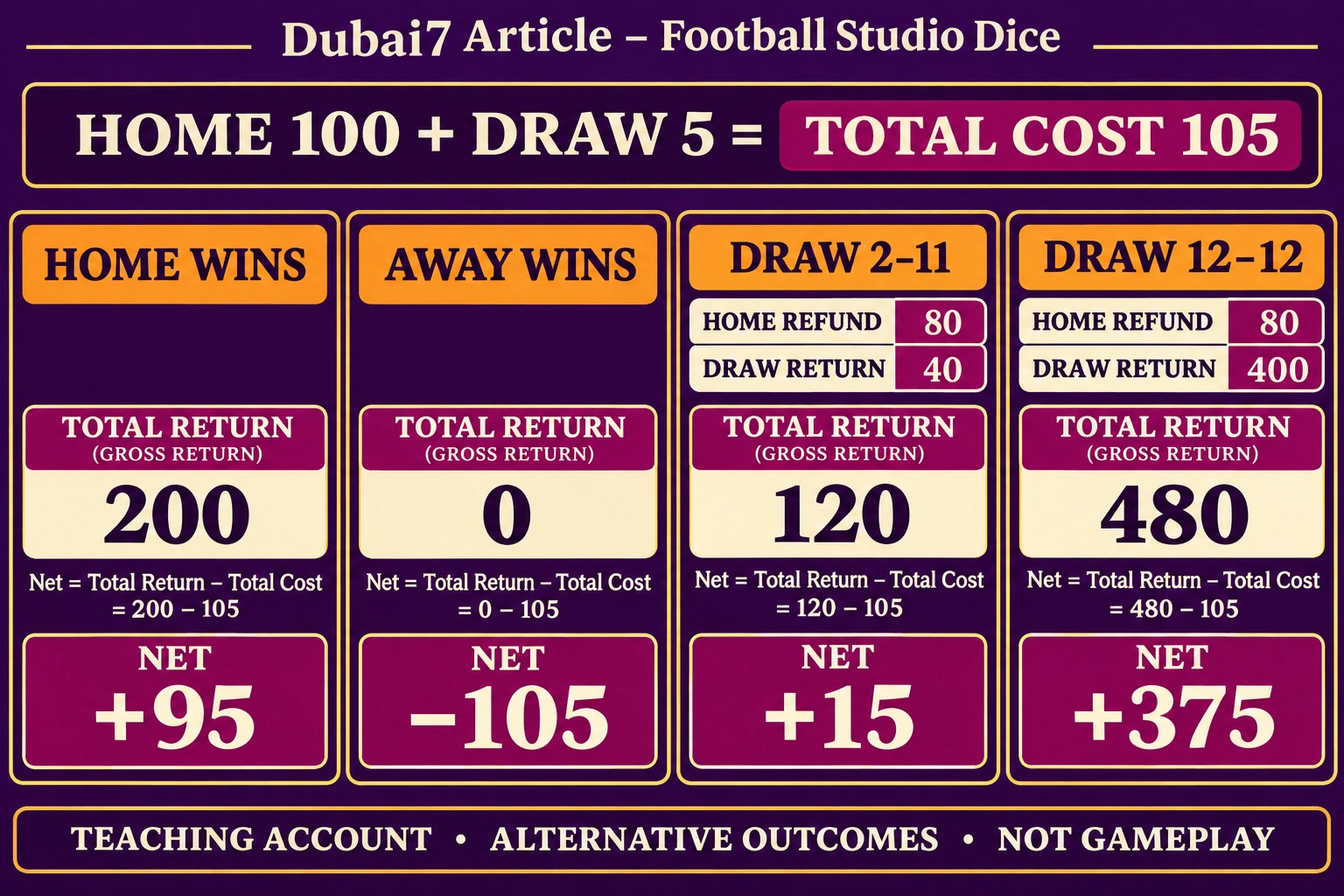
Suppose a recorded round contains a 100-unit Home bet and a five-unit Draw bet. Its total purchase is 105 units. These are hypothetical amounts used to expose the accounting; they are not a recommended betting combination or a claim about table limits.
On an ordinary Draw, the account receives 80 from Home and 40 from Draw. The total return is 120, so the whole-round net is 120 − 105 = +15. Calling the five-unit Draw’s 35-unit profit the entire round’s profit would ignore the 20-unit loss on Home.
On Draw 12, the account receives the same 80-unit Home refund plus 400 from Draw. Total return is 480 and the whole-round net is 480 − 105 = +375. The 400-unit Draw return already contains the five-unit Draw stake; it is not 400 plus another five.
| Alternative final result | Total return from both bets | Net after the 105-unit cost |
|---|---|---|
| Home wins | 200 | +95 |
| Away wins | 0 | −105 |
| Ordinary Draw | 120 | +15 |
| Draw 12 | 480 | +375 |
Starting from 1,000 units, the account falls to 895 when the bets are accepted. Crediting the appropriate return then produces 1,095, 895, 1,015 or 1,375. These are four alternative endings for one round, not amounts to add across a single outcome.
The Away-win branch is why the added Draw bet does not make this combination risk-free. It still loses the entire 105-unit cost in that branch. A profitable-looking Draw account does not remove the non-Draw outcomes or create a guaranteed return.
Why 12–12 is not one of eleven equally likely Draws
Two six-sided dice can make totals from 2 to 12, but those totals do not have equal numbers of combinations. Total 12 requires 6 + 6. Total 7 has six ordered combinations: 1 + 6, 2 + 5, 3 + 4, 4 + 3, 5 + 2 and 6 + 1.
Under an explicit model of four independent fair six-sided dice, there are 6⁴ = 1,296 ordered outcomes. For a Draw on 7, either side has six combinations, so there are 6 × 6 = 36 matching-total outcomes. For a Draw on 12, each side has only one combination, giving one outcome: all four dice show 6.
| Equal total on both sides | Ways for one side | Four-dice Draw combinations |
|---|---|---|
| 2 or 12, considered separately | 1 | 1 for each total |
| 3 or 11, considered separately | 2 | 4 for each total |
| 4 or 10, considered separately | 3 | 9 for each total |
| 5 or 9, considered separately | 4 | 16 for each total |
| 6 or 8, considered separately | 5 | 25 for each total |
| 7 | 6 | 36 |
Adding every total gives 146 Draw outcomes: 145 ordinary Draws and one Draw 12. In this model, Draw 12 is 1/1,296 of all rounds, or 1/146 of Draw rounds. Those are different denominators. Neither is 1/11 just because there are eleven possible equal totals.
This is a mathematical model, not a measurement of a particular live table’s physical dice. It explains why the exceptional payout cannot be treated as the usual return whenever a Draw appears. Previous results, or the fact that Draw 12 has not appeared recently, do not change the model’s next-round calculation.
Check the average against the full payout schedule
The model contains 575 Home wins, 575 Away wins, 145 ordinary Draws and one Draw 12. For a one-unit Draw bet, gross returns therefore sum to 145 × 8 + 1 × 80 = 1,240 across the 1,296 equally weighted outcomes. The theoretical average gross return is 1,240/1,296 ≈ 95.679% of the stake.
For a one-unit Home bet, the corresponding calculation is (575 × 2 + 146 × 0.8)/1,296 ≈ 97.747%. These round to the named published rules’ 95.68% for Draw and 97.75% for Home/Away. They are long-run model averages, not a promise that any session gives back those percentages.
The illustrative 100-plus-five combination has a model expected net of about −2.469 units per 105 units staked, after including all four branches. Showing a positive net in the two Draw branches does not make the weighted average positive. You need the losing branch and the relative number of outcomes too.
Questions worth resolving before comparing a return
Does a combined total of 12 qualify for the special payout?
No. The special condition is a Draw with a two-dice total of 12 on each side: Home 12 and Away 12. Home 6 versus Away 6 has a combined four-dice total of 12, but it is an ordinary Draw on 6, paying the ordinary Draw rate.
Is the returned 80% a separate win?
It is a partial return of a Home/Away stake on a Draw. On 100 units, 80 returned means a 20-unit loss on that bet. It does not become a full refund because a separately placed Draw bet wins.
What if only the first-half score is visible in a screenshot?
That does not establish the final totals. Retain the second-half dice as well, identify which die belongs to each side, and match the result with the actual bet record. A first-half 6–6 could finish as an ordinary Draw, a Draw 12, or a non-Draw depending on the second half.
Can I apply these rates to another similarly named game?
Use the rules for the exact game and version. This account is for the published Football Studio Dice schedule. It does not establish the payout of card-based Football Studio, Bac Bo, or another four-dice game, and it excludes any unverified fee or limit adjustment to the example.
Sources: published Evolution Services rules, Football Studio Dice chapter and Loto-Québec’s Football Studio Dice rules, pages 1–2. Dubai7 created the examples, independent four-dice calculation and diagram. The diagram is an explanation, not a game screenshot.